
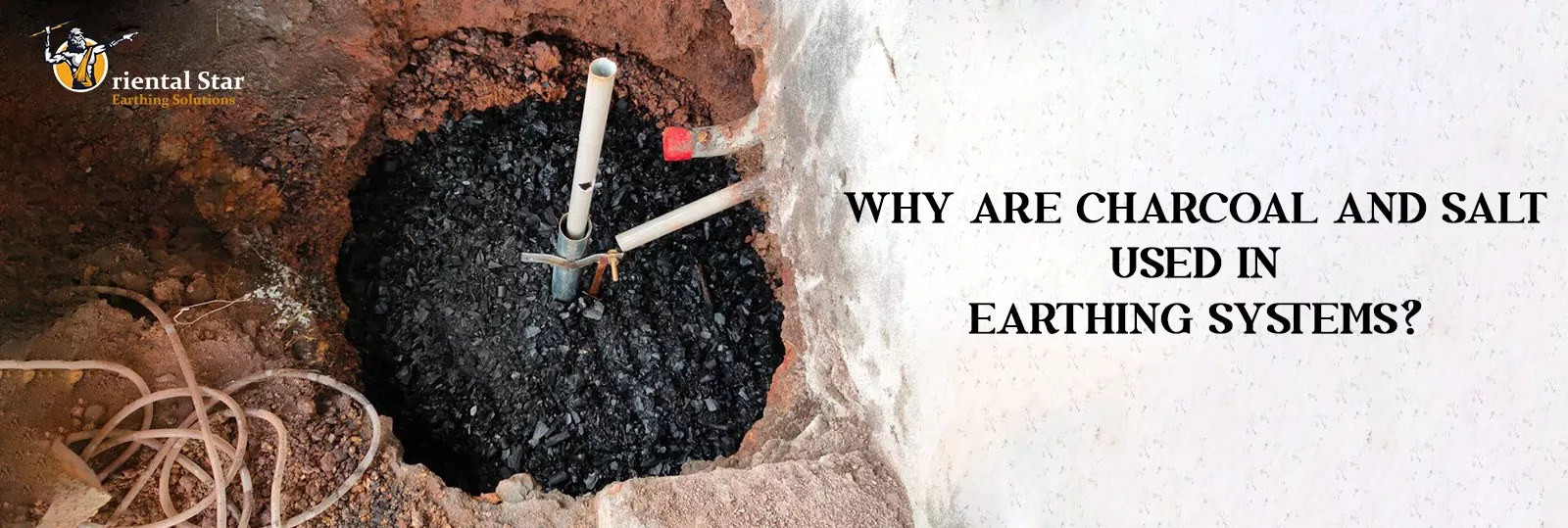
Earthing is important for electrical safety as it provides a low-resistance path for fault current to flow to earth. The consistent earthing systems used in homes, industries and commercial places guarantee minimal risk of electrical shocks, equipment failure, and voltage irregularities. “However, among various materials applied in conventional earthing, charcoal and salt are well known to increase the conductivity of the soil.” Why these materials are used to ground will provide insight into the development of safer and more efficient grounding systems.
What is Earthing and Why Is It Important?
Earthing is the practice of connecting electrical equipment to the earth by a wire so that any excess electricity within the equipment can safely flow into the ground. It stops electrical shock hazards, balances voltage, reduces fire hazards, and shields home appliances during electrical faults. The effectiveness of earthing is primarily influenced by the soil resistivity, which should be low for proper current flow.
Why Traditional Earthing Uses Charcoal and Salt?
In many areas, the resistivity of the soil is highly variable because of the climate and the type of soil. Dry, rocky or sandy soils tend to have a high resistivity, so that an earth electrode requires a very large spacing for earthing. To compensate for that, additional materials that coat the earth and the moisture and reduce the resistivity of soil. This is where charcoal and salt came into favor for conductive and moisture-retaining qualities.
Role of Charcoal in Earthing
Charcoal is made of carbon, which possesses good conductive characteristics. Its porous nature allows it to retain moisture for prolonged periods. This moisture helps maintain consistent conductivity around the electrode. The porous structure also prevents soil compaction, allowing better contact between the electrode and the surrounding material. When mixed inside the pit, Charcoal for earthing helps create a more stable and low-resistance environment suitable for efficient grounding.
Role of Salt in Earthing
Salt is a natural electrolyte and raises the concentration of ions in the soil. In the presence of water, salt dissolves and reduces the bulk resistivity by allowing the easier flow of the electric current. The use of Earthing Salt is also to be discouraged as too much salt can cause corrosion to metallic plates and could have an adverse affect to the soil over time. Salt has been popularly used to improve earthing in places where the bare earth was felt to be insufficiently conducting, despite this drawback.
How Charcoal and Salt Work Together in Earthing?
When the charcoal and salt are used together, then it creates a conductive layer around the electrode. Charcoal holds on to moisture, and salt dissolves, making the environment rich in electrolytes. They work in tandem to increase current flow dissipation and also help keep resistivity lower. This mixture has been popularized for use in traditional earthing pits, particularly for smaller residential or temporary works.
Advantages of Using Charcoal and Salt in Earthing
Charcoal and salt are inexpensive and readily available. They enhance conductivity in medium resistivity soils and are easy to install without the need for special tools or equipment. For light-duty use, or for a plain grounding point, this approach can give decent results if it is not neglected.
Limitations of Charcoal-Salt Earthing
The charcoal and salt earthing solution is good, but it has a few disadvantages. It is also very much dependent on moisture in the air and needs to be watered from time to time, more so in dry weather. The salt can dissolve, which decreases the conductivity. In addition, salt increases the rate of corrosion of the electrodes, reducing their useful life. It is not applicable in high-power or industrial applications where stable, long-term earthing is a must.
Modern Alternative: Chemical Earthing Systems
Modern grounding systems employ special compounds and electrodes resistant to corrosion to provide enduring performance. Such systems employ conductive backfill materials that hold moisture and keep the resistance level constant for a long time, and they are less maintenance-dependent. Chemical earthing systems generally last twice the life of conventional charcoal-salt pits, and apply to both home and industrial solutions.
When to Use Charcoal and Salt in Earthing?
This method is still preferred in areas with limited access to chemical earthing materials or for low-budget projects. It is useful for temporary structures, small domestic loads, and rural installations. When implemented correctly and maintained, it can deliver acceptable performance for basic applications.
How to Install Charcoal and Salt Earthing?
A normal practice is to dig an earthing pit, insert the electrode vertically and then pack the soil around the electrode with alternate layers of charcoal and salt. Crumbs of soil are added to fill the gaps, then water is added to settle the mixture. Testing on a regular basis keeps the system operational. Proper layering, moisture, and good compaction (not too much!) all contribute to the overall success of the application.
Maintenance Tips
For long life, the pit should be watered from time to time. The earth resistance should be periodically tested for variation. The pit dustcover must be kept intact for the protection of the internal parts. Salt avoidance reduces corrosion and electrode life.
Common Misconceptions
The addition of salt does not necessarily enhance earthing and may instead hasten the rusting process. Charcoal does not act as a voltage stabilizer, but it does conduct electricity. The classic charcoal-salt method of earthing is not a permanent solution. It is also powerless against very high soil resistivity by itself.
Environmental Concerns
Excess salt affects soil composition, nearby plantations, and groundwater. Corrosion from metal components can add contaminants to the soil. Modern earthing systems are more environmentally friendly due to minimal leaching and longer lifespan.
Conclusion
The traditional system of grounding with charcoal and salt was popularised in the good old days due to its conductivity enhancement of the soil and decrease in resistance. They still work well for light-duty applications, but are being surpassed by more modern materials with better longevity and performance. At Oriental Star Earthing Solutions, we lead our clients to safer and superior earthing solutions. For any questions, contact us at any time to find the best grounding solution for your needs.